

A uv curing light sounds like a single product, but it is really a category of tools built for very different jobs. Pet stain detection, gel manicures, and resin jewelry all rely on ultraviolet wavelengths to do their work, yet each craft rewards a different beam, footprint, and lamp layout. Picking the right output matters more than picking a familiar brand.
You will see a mix of handheld flashlights, manicure lamps, and resin curing stations in this guide. Each one below fits a specific workflow, and the trade-offs get spelled out honestly so you spend on a light that actually matches the project on your desk.
A Quick View Of The Lineup
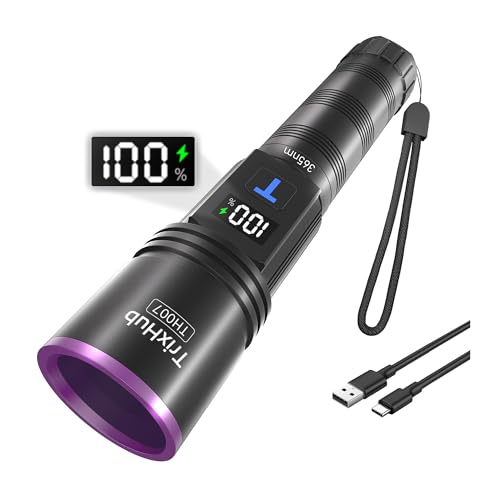
TrixHub 365nm UV Flashlight Rechargeable with LCD Display

GAOY Professional UV Nail Lamp for Long Nails

Suzzam 36W Double-Sided UV Light for Resin

Resiners G3 Resin Curing Machine for DIY Decor

LET’S RESIN Portable UV Resin Curing Lamp
Meet The Standout Selections
The TrixHub 365nm UV flashlight sits in a different lane from the resin and nail lamps further down this list, and that is exactly the point. A 365nm long-wave beam is the wavelength most often used for fluorescence detection, which is why this style of light shows up in pet stain hunting, hotel housekeeping, and mineral ID work. The 30W output rating and rechargeable build push it well above novelty-tier blacklights, while the built-in LCD display lets you monitor remaining charge at a glance.
For most households, the realistic scenario is a guest-friendly tool rather than a science instrument. The flashlight form factor makes it easy to sweep across a rug or mattress seam, and unlike the manicure and resin lamps in this guide, you can carry it outside to check security features or scan a yard at night. Skip shining it directly in eyes, since long-wave UV at this output can cause discomfort.
What Earns Its Place
- 365nm wavelength is the standard band for fluorescence detection, making dried pet stains and certain minerals clearly visible.
- 30W output rating delivers a strong, focused beam that holds up across a dark room or large carpeted area.
- Rechargeable battery with on-board LCD readout removes guesswork about remaining runtime between sessions.
- Handheld flashlight format reaches corners and tight seams that a clamshell nail lamp simply cannot access.
Honest Caveats
- Long-wave UV output means direct eye exposure is uncomfortable, so a quick safety pass before use pays off.
- Detection results depend on ambient darkness; in bright daylight the visible fluorescence effect drops sharply.
- Best used as a detection tool rather than a curing lamp, so it does not double as a resin or gel nail solution.
Feature Snapshot
Built With In Mind
Pet owners, home inspectors, and hobbyist mineral collectors who want a focused 365nm beam for spot detection work.
Consider Something Else When
You want a curing lamp for gel polish instead, in which case the GAOY Professional UV Nail Lamp further down the list is the right tool for that job.
Where the TrixHub is built for inspection, the GAOY Professional UV Nail Lamp is purpose-built around a different problem: gel polish that never fully sets. Its 6.2 by 6.2 inch inner cavity is the headline feature, because most compact manicure lamps pinch the fingertips of anyone with longer nails or full press-on sets. The wider geometry gives every finger consistent distance from the LEDs, which is the difference between a sticky edge and a fully cured set.
This lamp only cures gel polish, not traditional air-dry lacquer, so pairing it with a gel-friendly routine matters. Smart sensor activation and adjustable timers round out the build, helping avoid the over-cure that makes gel feel brittle after a few weeks. For at-home users, the trade-off is mainly footprint: it is bigger than travel lamps, but the cavity space makes that footprint pay off.
What Pays Off
- 6.2 by 6.2 inch inner cavity accommodates longer nails and full press-on sets without crowding fingertips against the LEDs.
- Wider geometry produces more even coverage, so a single timed cycle usually cures all five nails consistently.
- Smart sensor activation means hands slide in and the lamp starts, cutting down on fumbling with buttons mid-manicure.
- Adjustable timer settings let you match cure length to different gel brands without overdoing the exposure.
Trade Offs
- Engineered only for gel polish, so traditional lacquer will not dry under this lamp at all.
- Larger cavity means a bigger desk footprint than compact travel-style nail lights.
Right Fit For
At-home gel manicure users with longer nails, press-on sets, or anyone tired of fingertips brushing the lamp walls during a cure.
A Better Fit Elsewhere
You mostly work with UV resin jewelry or small castings, where the LET’S RESIN Portable UV Resin Curing Lamp or the Suzzam 36W Double-Sided model serve a different craft entirely.
Resin crafters know the slowest part of any project: flipping a mold to cure the underside. The Suzzam 36W Double-Sided UV Light tackles that exact bottleneck. Two panels share a magnetic connection, so powering one side lights both, which means a coaster or pendant gets even exposure on every face without manual flipping. Twenty-four lamp beads distribute 365nm and 405nm dual-wavelength output around each piece, addressing the two most common UV resin cure ranges.
The 36W power rating lands in a useful middle ground for hobby use, fast enough for thin jewelry pours, gentle enough that thicker layers still cure through. The build separates for single-sided projects when a wider mold is in play, which adds flexibility that fixed-box lamps cannot match. The honest read is that this is a craft tool, not a lab instrument, so very large castings will still benefit from the heated Resiners G3 in the next slot.
Reasons It Performs
- 365nm plus 405nm dual-wavelength output covers the cure bands most UV resin brands rely on.
- Magnetic two-panel design cures both sides at once, eliminating the manual flip step on jewelry and coaster pours.
- Twenty-four evenly distributed lamp beads reduce hot spots and shadowed edges on irregular molds.
- Panels separate for use as a single wider lamp on larger flat projects, which broadens the use cases.
Worth Bearing In Mind
- Designed for UV resin only, so deep epoxy pours that need heat are not its strong suit.
- Two-panel setup takes up more bench space than a single-box lamp during storage.
- Magnetic connection needs to be kept clean, since resin drips on the contacts can interrupt the circuit.
Made For
Resin jewelry makers and small-mold crafters who want faster, even cures on pendants, earrings, and coasters without flipping each piece by hand.
Reach For A Different Pick When
You pour deep epoxy blanks or larger castings that need heat-assisted curing, in which case the Resiners G3 Resin Curing Machine is the upgrade worth considering.
The Resiners G3 is the only pick in this guide that combines hot air circulation with UV light, and that combination changes the workflow for serious resin work. Epoxy deep pours can take 24 hours to fully cure at room temperature, but the G3’s heated chamber drops that to roughly two hours, while thin UV resin pieces set in about a minute. For anyone running a small batch production or a workshop table, the time savings add up fast.
It is also the only item here that is genuinely a machine, not a lamp, so expectations should adjust accordingly. The unit heats only, with no active cooling, so the lowest achievable chamber temperature tracks with the room it sits in. Factor that into where you set it up, and you get a tool that pays for itself in throughput.
Strengths Worth Knowing
- Dual curing approach handles both deep epoxy pours and thin UV resin layers in one station.
- Heated chamber cuts long epoxy cure times down to roughly two hours for small batches.
- UV resin still cures in about a minute, matching the speed of the dedicated lamps in this roundup.
- Single-machine footprint replaces a separate heat box and UV lamp on a craft bench.
Practical Considerations
- No active cooling means the chamber cannot drop below ambient room temperature, which matters in warmer studios.
- Larger and heavier than a handheld resin lamp, so it works best on a fixed workstation rather than a portable setup.
- Priced above single-purpose lamps, so casual hobbyists may not need the dual curing capability.
Feature Snapshot
Best Suited To
Workshop crafters, small-batch producers, and serious hobbyists who work with both epoxy and UV resin and want faster turnarounds on bigger pours.
Skip It When
You mostly cure small UV resin pendants at the kitchen table, where the lighter Suzzam 36W Double-Sided UV Light or LET’S RESIN Portable Curing Lamp do the job at a friendlier size.
The LET’S RESIN Portable Curing Lamp rounds out this list as a friendly entry point for anyone just starting with UV resin. Eighteen dual-source lamp beads spread across the panel, and the housing accepts a 12 by 20 cm mold in a single pass, which is a useful benchmark for pendant trays and bookmark blanks. The portable format means it tucks into a craft drawer between sessions rather than claiming permanent bench space.
Compared with the Suzzam two-panel setup, this is a single-box design, so you will still flip thicker pieces manually. The payoff is a smaller footprint and a friendlier learning curve for first-time resin crafters. For most casual projects, the cure speed holds up, though very thick pours will not benefit as much as they would under a heated station like the Resiners G3.
Real Benefits
- Single-box portable design suits small craft areas and clears away easily between sessions.
- Eighteen dual-source lamp beads deliver even coverage across a 12 by 20 cm mold area.
- Low entry complexity makes it approachable for first-time UV resin users.
Where It May Fall Short
- Single-sided design means flipping thicker molds by hand for full cure.
- Better matched to thin UV resin pours than deep epoxy or large castings.
- No heated chamber, so cure time for thicker pieces still depends on resin chemistry and ambient conditions.
Whose Shelf It Belongs On
New resin crafters, casual hobbyists, and anyone wanting a portable curing lamp for thin jewelry and small mold projects.
Where A Sibling Pick Shines
You want double-sided curing without manual flipping, in which case the Suzzam 36W Double-Sided UV Light is the better step up at a similar hobbyist scale.
What Matters Before Choosing uv curing lights
The first decision point is wavelength. UV resin typically cures under 365nm or 405nm, while detection tasks like pet stain hunting rely on the 365nm long-wave band. Nail lamps tend to combine multiple wavelengths to cover different gel formulas, so the match between lamp output and the polish you use matters more than raw wattage.
Next, look at the form factor. Handheld flashlights reach places clamshell lamps cannot, but they are poor fits for setting a gel manicure. Box-style lamps cure from one or two sides and work well for thin resin pieces, while heated chambers handle the deep epoxy pours that take a day at room temperature.
Cure time and batch size are the practical trade-offs. Faster curing often comes from closer LED spacing and stronger output, but a lamp optimized for thin layers may struggle with thicker castings. Match the chamber depth, mold size, and project volume to the lamp geometry rather than chasing peak wattage on paper.
Finally, think about your workspace. A heavy heated machine anchors a fixed workstation, while a portable lamp slips into a closet between sessions. Pick the form factor that matches how often you actually sit down to use it.
Key Considerations Across These Picks
Common Shopping Slip Ups
The most common mistake is buying a detection flashlight for a gel manicure, or a nail lamp for resin casting. The wavelengths and geometries look similar at a glance, but the cure profiles are different. A second slip is ignoring mold or hand size; lamps that look roomy online can feel cramped on a long nail or a wide coaster. Measure your largest project before choosing chamber depth.
Where The Extra Money Goes
Higher tier models in this category usually add dual-wavelength output, larger curing chambers, or heated curing for thick epoxy. For most casual resin users, a single-sided or double-sided UV lamp is plenty. The upgrade to a heated chamber makes sense once you start running small batches or want same-day turnaround on deep pours, which is when the time savings start to justify the higher spend.
Frequently Asked Questions
What wavelength uv curing light do most gel polishes need? Most gel polish formulas cure under 365nm or 405nm, and a good nail lamp covers both bands. Single-wavelength lamps can leave some formulas undercured, so a dual-wavelength build is the safer pick for mixed polish collections.
Can a uv resin lamp also cure gel nails? The wavelengths overlap, but the geometries rarely do. Resin lamps are typically open boxes for flat molds, while gel nail lamps form a closed cavity around the hand, so swapping them usually leads to uneven cures.
How long does uv resin take to cure under a lamp? Thin layers of UV resin usually set in about one to two minutes under a properly matched lamp. Thicker pours benefit from layered cures or a heated chamber, since UV light struggles to penetrate deep resin.
Are uv curing lights safe to use at home? Used as directed, these lamps are safe for household craft and beauty work. Avoid direct eye exposure to the beam, follow the resin or polish manufacturer’s instructions, and keep the lamp out of reach of children during operation.
How do I clean resin drips off a uv curing lamp? Wipe cured drips off glass and housing with a soft cloth and a small amount of isopropyl alcohol. Uncured resin wipes away more easily, but a magnetic-contact lamp like the Suzzam benefits from keeping the contact points clean to maintain the connection between panels.
Final Verdict
The right uv curing light depends entirely on what you are making. Pet stain hunters and inspectors will get the most from the TrixHub flashlight, gel manicure fans from the GAOY, and resin crafters from the Suzzam, Resiners G3, or LET’S RESIN depending on project size. Match the wavelength and form factor to your craft, and the rest of the decision tends to fall into place.
