

Perfume notes form the foundation of any fragrance, and a comprehensive Fragrance Guide can help you navigate these elements. They represent the different layers of scent that evolve over time. Understanding these notes helps you appreciate a fragrance’s complexity. Concentrations play a crucial role in how a perfume smells and lasts. Higher concentrations often mean stronger scents, but they can also affect how long the fragrance stays with you. Factors like skin chemistry and climate can influence this. Knowing about notes and concentrations, as outlined in a Fragrance Guide, empowers you to make informed choices when selecting your next fragrance.
Key Takeaways
Understand the three types of perfume notes: top, middle, and base. Each note plays a vital role in the fragrance experience.
Choose the right perfume concentration based on your needs. Higher concentrations like Parfum last longer, while lighter options like Eau de Cologne are refreshing for short durations.
Consider your skin type when selecting a fragrance. Oily skin retains scents better, enhancing longevity.
Apply perfume to warm pulse points for the best scent release. Moisturizing your skin beforehand can also help the fragrance last longer.
Select fragrances based on the occasion and season. Lighter scents suit casual wear and warm months, while richer scents are ideal for formal events and colder seasons.
Fragrance Guide to Perfume Notes
Top Notes
Top notes are the first scents you experience when you apply a perfume. They create an immediate impression and typically last for about 5 to 15 minutes. These notes are often light, fresh, and invigorating. Common examples include citrus oils like lemon and bergamot.
Top notes play a crucial role in shaping your initial emotional reaction to a fragrance. They set expectations about the overall character of the perfume. Here are some key influences of top notes:
They create immediate emotional reactions.
They set expectations about the fragrance’s overall character.
They influence initial purchase decisions.
They determine whether you continue sampling the scent.
They provide a preview of the fragrance’s underlying personality.
Some popular ingredients used in top notes include:
Bergamot
Blackcurrant bud
Cassis
Citron
Cyclamen
Frangipani
Galbanum
Jasmine
Ylang Ylang
Middle Notes
Middle notes, also known as heart notes, emerge after the top notes fade. They typically last from 20 to 60 minutes and form the core of the fragrance. These notes are essential for defining the perfume’s primary personality. They bridge the initial burst of scent from the top notes to the deeper base notes.
Middle notes provide depth and character, ensuring a cohesive fragrance experience. They typically last a few hours, which helps maintain the fragrance’s identity. Here are some characteristics of middle notes:
They step forward once the top notes dissipate.
They remain noticeable for a longer duration.
They help shape the fragrance’s central identity.
Common middle notes found in best-selling perfumes include:
Lavender
Clary Sage
Sweet Marjoram
Neroli
Rose
Fragonia
Geranium
Fennel
Cardamom
Base Notes
Base notes are the final layer of a fragrance. They provide depth and longevity, lasting the longest of all the notes. These deep, rich scents linger after the lighter notes have faded. Base notes are essential for leaving a lasting impression and contribute significantly to the overall fragrance profile.
The characteristics of base notes include:
They serve as the foundation of a fragrance.
They provide essential depth and warmth.
They develop over time, contributing to the lasting impression.
Base notes enhance the longevity of fragrances due to their heavier molecular structure. This allows them to remain on the skin for extended periods, creating a memorable scent experience. Common base notes include:
Sandalwood
Amber
Vanilla
Understanding these three types of notes—top, middle, and base—helps you appreciate the complexity of fragrances. Each note plays a vital role in the overall scent experience, allowing you to choose perfumes that resonate with your personal style.
Understanding Perfume Concentrations
When choosing a fragrance, understanding perfume concentrations is essential. The concentration of aromatic compounds in a perfume determines its strength and longevity. Here are the main types of perfume concentrations:
Parfum
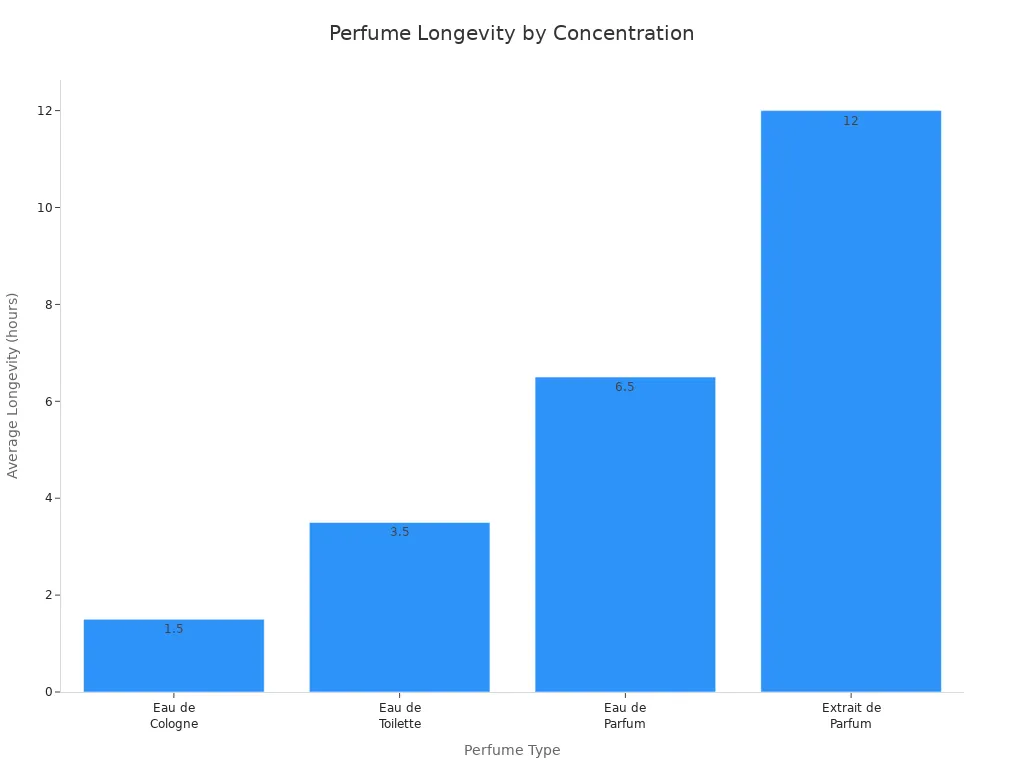
Parfum, also known as Extrait de Parfum, contains the highest concentration of fragrance oils, typically ranging from 20% to 40%. This high concentration allows Parfum to last significantly longer than other types. You can expect it to linger on your skin for 10 to 16 hours or more. The richness of Parfum provides a deep and intense scent experience, making it ideal for special occasions or evening wear.
Eau de Parfum
Eau de Parfum has a concentration of 15% to 20% fragrance oils. This concentration strikes a balance between strength and longevity, lasting about 4 to 8 hours. Eau de Parfum offers a robust scent profile, making it suitable for daily wear. It provides a noticeable presence without being overwhelming.
Type | Concentration | Longevity |
|---|---|---|
Extrait de Parfum | 20% to 40% | 8 to 12+ hours |
Eau de Parfum | 15% to 20% | 4 to 8 hours |
Eau de Toilette
Eau de Toilette typically contains 5% to 15% aromatic compounds, with an average concentration around 10%. This type of perfume lasts about 3 to 5 hours. It offers a lighter scent, making it perfect for casual settings or warmer weather. You can enjoy a refreshing burst of fragrance without it being too overpowering.
Fragrance Type | Average Longevity |
|---|---|
Eau de Toilette | 4 to 6 hours |
Eau de Parfum | 6 to 8 hours or more |
Eau de Cologne
Eau de Cologne has the lowest concentration, usually between 2% and 5%. This results in a light, bright scent that lasts about 1 to 2 hours. The fragrance is often citrus-forward, making it ideal for hot climates or quick refreshes throughout the day.
Concentration | Scent Characteristics | Duration |
|---|---|---|
2-5% | Bright, citrus-forward | 1-2 hours |
Understanding these types of perfume concentrations helps you choose the right concentration for your needs. Higher concentrations, like Parfum, ensure longer-lasting scents and stronger sillage, while lighter options, like Eau de Cologne, provide a refreshing experience for shorter durations.
Remember, the concentration of aromatic compounds correlates directly with fragrance longevity and projection. Higher concentrations allow for a gradual release of fragrance notes, enhancing your overall experience.
By understanding these differences, you can make informed decisions about which fragrance to wear for various occasions.
Longevity of Fragrances
Longevity refers to how long a fragrance lasts after you apply it. This factor is crucial when selecting a perfume. A scent that lasts longer can provide better value and enhance your overall experience. For example, Eau de Parfum typically lasts between 6 to 8 hours, making it a popular choice for those seeking long-lasting scents.
Factors Affecting Longevity
Several factors influence fragrance longevity. Here are some key elements to consider:
Concentration: Higher concentrations of fragrance oils lead to longer-lasting scents. Parfum, with its high concentration, often lasts the longest.
Skin Type: Your skin type plays a significant role. Oily skin retains fragrances better, while dry skin may cause scents to fade quickly.
Application Method: Applying perfume to warm pulse points, such as your wrists or neck, can enhance longevity. Moisturizing your skin before application also helps.
Environmental Conditions: Temperature and humidity affect how long a fragrance lasts. High temperatures can increase evaporation, while cooler conditions may help the scent linger longer.
Factor | Effect on Longevity |
|---|---|
Concentration | Higher concentrations lead to longer-lasting scents. |
Skin Type | Oily skin holds fragrance better than dry skin. |
Temperature | High temperatures increase evaporation, reducing longevity. |
Humidity | High humidity can slow evaporation of heavier notes. |
Testing Longevity
To test the longevity of fragrances, various methods are used:
Sensory Panel: Trained panels evaluate fragrance intensity at set intervals.
Closed Chamber Tests: These tests measure fragrance strength in controlled environments.
Consumer Feedback: Gathering user experiences helps assess perceived longevity during normal use.
Understanding these factors and testing methods can help you choose a fragrance that meets your needs. By considering concentration, skin type, and application techniques, you can enjoy a scent that lasts throughout your day.
Choosing Perfume for Occasions
Casual vs. Formal
Selecting the right perfume for different occasions can enhance your overall experience. Casual fragrances often feature lighter, fresher notes. They are versatile and suitable for everyday wear. In contrast, formal fragrances tend to be richer and more complex. They often include deeper notes that convey sophistication.
Here’s a quick guide to help you choose:
Occasion Type | Recommended Scents | Examples |
|---|---|---|
Formal | Oud, leather, amber, vanilla | ‘The Legend’ by Nisara Beauty |
Casual | Citrus, aquatic, fruity | ‘Blue Seduction’ by Nisara Beauty |
Casual fragrances appeal to a broad audience. They are designed for daily use and often feature accessible scents. Formal fragrances, however, are reserved for special occasions. They attract selective consumers who appreciate intricate compositions.
Seasonal Choices
Seasons also play a significant role in fragrance selection. Warmer months call for lighter scents, while colder months suit richer fragrances.
Consider these seasonal tips:
Spring/Summer: Opt for fresh, floral, or citrus notes. These fragrances feel uplifting and vibrant.
Fall/Winter: Choose warmer, spicier, or woody notes. These scents provide comfort and depth.
Research shows that climate influences scent perception. For example, higher temperatures can reduce fragrance longevity. In hot weather, lighter scents may evaporate quickly. Conversely, in cooler conditions, fragrances can last longer.
Study | Findings |
|---|---|
2019 Study from Journal of Sensory Studies | Climate influences scent perception, altering fragrance performance by 25-50%. |
Research from International Fragrance Association (IFRA) | Higher temperatures reduce fragrance longevity from 8 hours in cool conditions to just 4 hours in 90°F heat. |
By considering both occasion and season, you can select the perfect perfume to wear. This approach ensures that your fragrance complements your style and the environment.
Understanding perfume notes, concentrations, and longevity is essential for selecting the right fragrance. Fragrances consist of top, heart, and base notes that unfold over time, creating a dynamic scent experience. Concentration plays a crucial role in longevity; higher concentrations like Eau de Parfum typically last longer due to their oil content.
When choosing a fragrance, consider your skin type, application method, and environmental conditions. Oily skin retains fragrance better, while applying perfume to pulse points enhances scent release. Use this knowledge to find a fragrance that matches your personal style and suits the occasion. Happy scent hunting! 🌸
FAQ
What are fragrance notes?
Fragrance notes are the different layers of scent in a perfume. They evolve over time, creating a complex scent experience. Each note contributes to the overall character of the fragrance.
How do I choose the right concentration?
Choose a concentration based on how long you want the scent to last. Parfum lasts the longest, while Eau de Cologne offers a lighter, refreshing option for short durations.
Can skin type affect fragrance longevity?
Yes, your skin type can impact how long a fragrance lasts. Oily skin retains scents better than dry skin, which may cause fragrances to fade quickly.
How should I apply perfume for the best results?
Apply perfume to warm pulse points, like your wrists and neck. This enhances the scent’s release. Moisturizing your skin before application can also help the fragrance last longer.
Are there seasonal fragrances?
Yes, certain fragrances suit different seasons. Light, fresh scents work well in spring and summer, while warmer, spicier notes are perfect for fall and winter.
