Watch complications are more than just additional features; they enhance your watch’s functionality and appeal. Understanding these complexities can deepen your appreciation for luxury watches. For example, the chronograph debuted in 1860, marking a significant milestone in watch history. Other complications, like moon phase displays, showcase lunar cycles with remarkable accuracy. Different brands approach these features uniquely, offering various types of chronographs and sophisticated moon phase complications. By exploring watch complications explained, you can elevate your experience as a watch enthusiast.
Key Takeaways
Watch complications, like chronographs and moon phases, enhance both functionality and style in luxury watches.
Chronographs allow you to measure elapsed time, making them useful for activities like sports and cooking.
Moon phase displays track lunar cycles accurately, requiring adjustments only once every 122 years.
GMT functions enable you to view two time zones at once, simplifying travel and scheduling across different regions.
Understanding these features deepens your appreciation for watch craftsmanship and can guide your purchasing decisions.
Chronograph Functions
How Chronographs Work
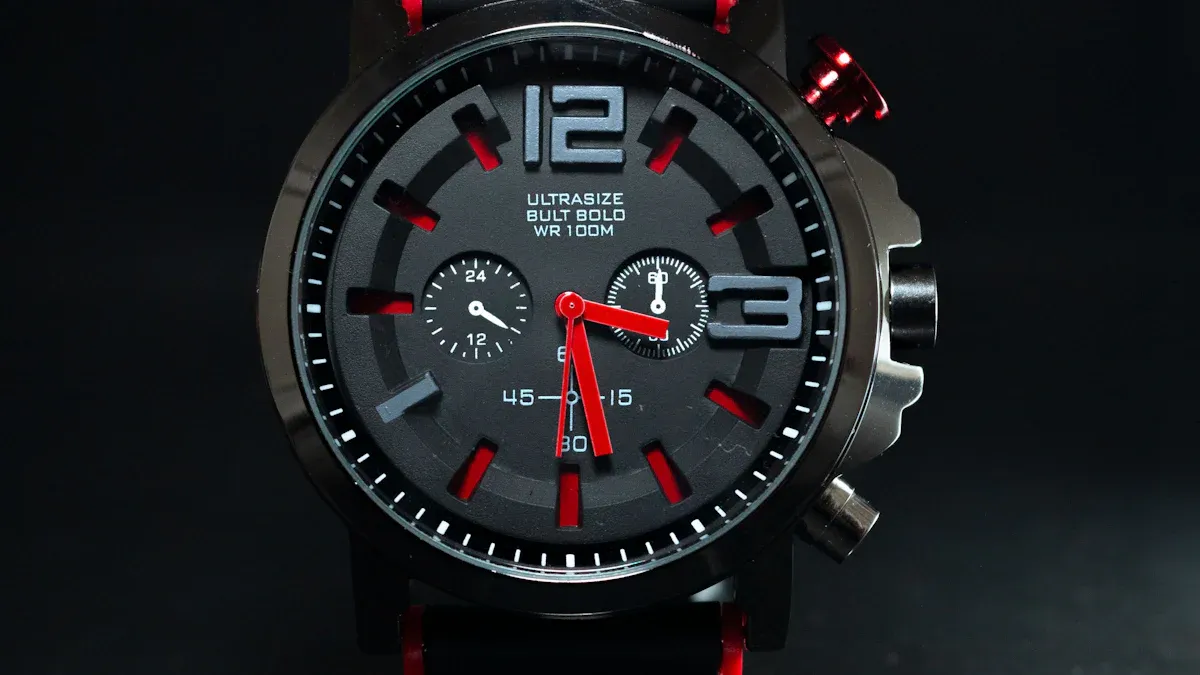
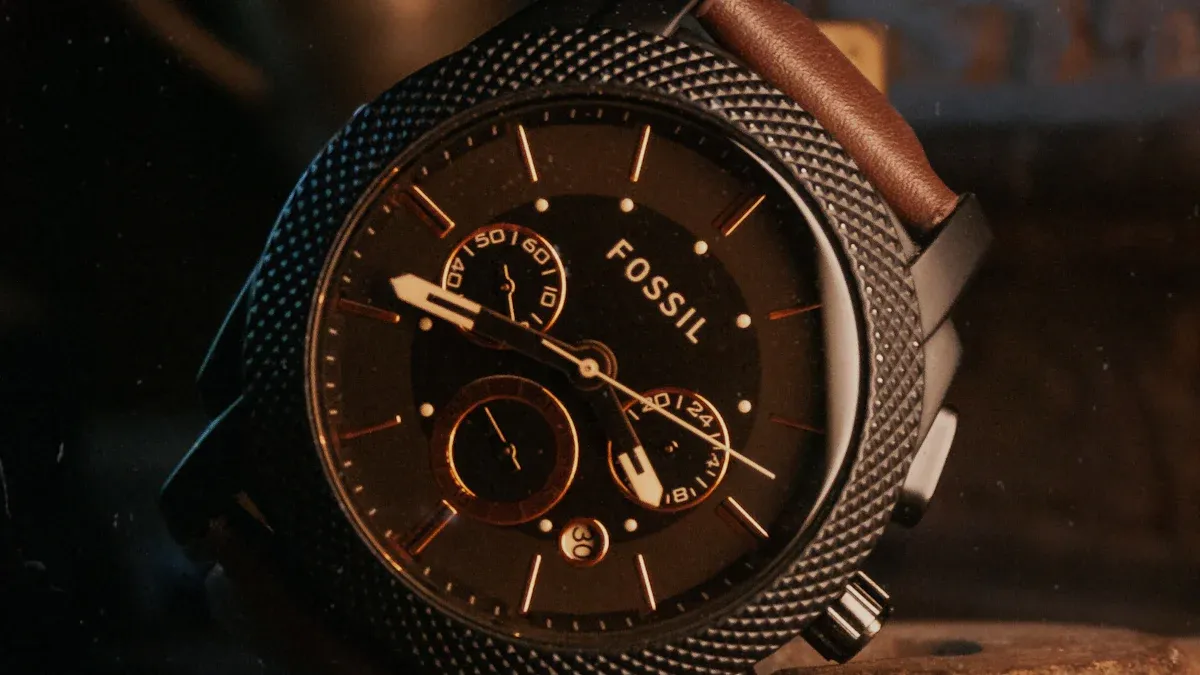
A chronograph is a type of watch that combines standard timekeeping with stopwatch capabilities. This unique feature allows you to measure elapsed time conveniently. The chronograph mechanism includes several key components:
Stopwatch Mechanism: This part is responsible for starting, stopping, and resetting the timer.
Pushers: These buttons activate the stopwatch mechanism.
Subdials: These display elapsed time in minutes and seconds.
To operate a chronograph, follow these simple steps:
Start: Press the top pusher to engage the chronograph hands.
Stop: Press the same pusher again to freeze the elapsed time.
Reset: Press the bottom pusher to return the hands to zero.
The chronograph’s origin dates back to the early 19th century. Nicolas Rieussec is credited with creating the first chronograph in 1821, but Louis Moinet developed the first true chronograph capable of timing to 1/60th of a second. Moinet’s design operated at an impressive 216,000 vibrations per hour. Rieussec later popularized the term “chronograph” and created a device for timing horse races. The transition to wristwatches began in 1913 with Longines’ monopusher chronograph.
Benefits of Using a Chronograph
Chronographs offer numerous advantages, making them popular among both professionals and casual users. Here are some practical applications of chronograph functions:
Aviation: Pilots use chronographs for navigational calculations and to track flight times.
Motorsports: Race car drivers measure lap speeds and track race times.
Medicine: Doctors utilize chronographs to measure pulse rates and time patient heartbeats.
For non-professional users, chronographs enhance daily utility. You can use them for:
Timing races or workouts
Measuring cooking intervals
Calculating speed over a known distance
A chronograph is more than just a timepiece; it adds functionality to your watch. With its precise timing capabilities, you can enjoy a blend of style and practicality in your daily life.
Comparison of Chronograph Mechanisms
Different types of chronograph mechanisms exist, each with unique features. Here’s a quick comparison:
Feature | Column Wheel Chronograph | Cam-Actuated Chronograph |
|---|---|---|
Construction | More labor-intensive, precise with tiny teeth | Simpler, allows for more ‘play’ in parts |
Performance | Smooth action, especially with vertical clutch | Reliable and accurate, approved for space flight |
Cost | Higher due to complexity and labor | Lower due to simpler production |
Servicing | More time-consuming, delicate nature | Easier, with simpler parts |
Market Position | Considered high-end, associated with luxury | Not seen as haute horlogerie, but still quality |
Understanding these chronograph functions can enhance your appreciation for watch complications. Whether you are a professional or a casual user, a chronograph can significantly improve your timekeeping experience.
Moon Phase Complications
Mechanics of Moon Phase Displays
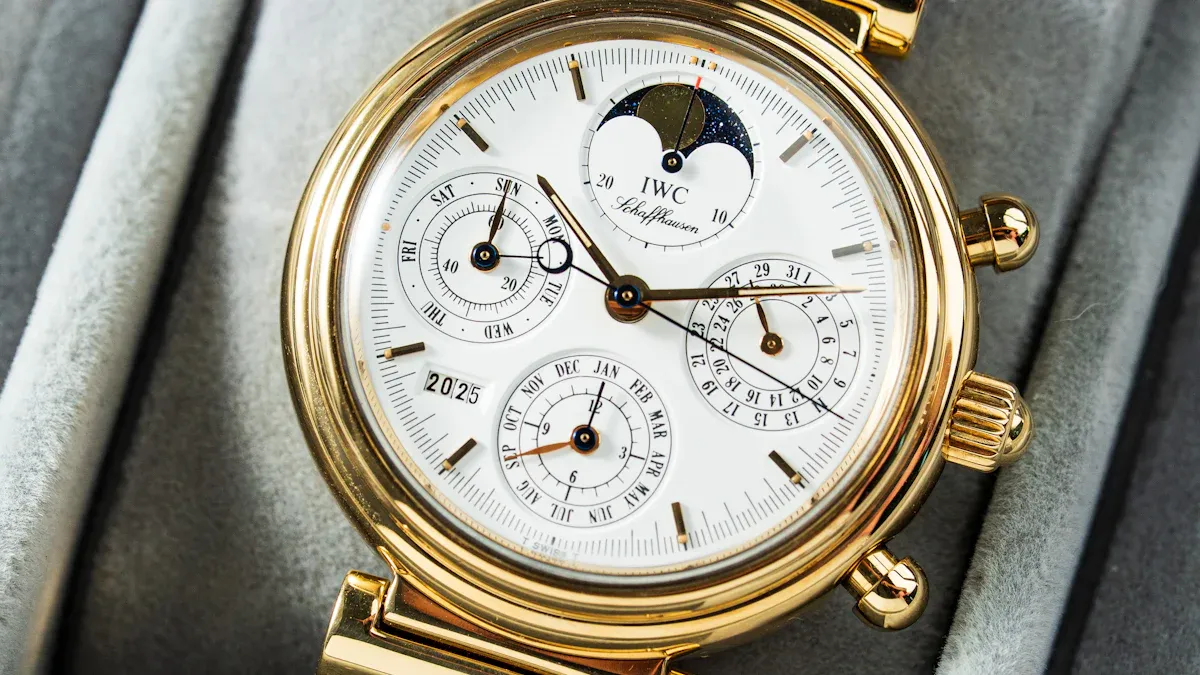
Moon phase complications track the lunar cycle, which lasts about 29.5 days. These displays use gear trains with specific ratios to represent the phases of the moon accurately. You only need to adjust these watches once every 122 years for optimal accuracy. This remarkable engineering allows you to see the current moon phase right on your wrist.
The moon phase indicator typically features a small window on the watch dial. This window shows the moon’s current phase, whether it’s a new moon, full moon, or somewhere in between. The visual representation of lunar cycles adds a unique charm to your watch.
Practical Uses of Moon Phase Watches
Moon phase watches serve several practical purposes. Here are some common uses:
Tracking Lunar Cycles: You can use these watches to monitor the moon’s phases, which can be helpful for various activities like fishing or gardening.
Investment Value: Many collectors view moon phase watches as valuable investments. Their intricate designs and high-quality materials often make them sought-after pieces.
Conversation Starters: The unique design of moon phase watches often sparks interest. You can share the fascinating history and mechanics behind these complications with others.
The accuracy of traditional moon phase displays is impressive. They can be off by only one day after 2.5 years, as shown in the table below:
Approximation of Lunar Month | Days Out of Sync After 2.5 Years |
|---|---|
29.5 days | 1 day |
The exact duration of a lunation is 29.530587981 days, requiring a correction of one day every 2.5 years. This precision reflects the watchmaker’s skill and dedication to craftsmanship.
Moon phase complications also enhance the aesthetic appeal of luxury watches. They often feature elegant designs, showcasing finely crafted moon phase indicators. Many of these timepieces use premium materials like gold and platinum, further elevating their luxurious nature.
GMT Functions Explained
How GMT Complications Work
A GMT complication, or Greenwich Mean Time complication, allows you to view two time zones simultaneously. This feature is especially useful for travelers and business professionals who frequently cross time zones. The mechanism originated in the 1950s for pilots but has since gained popularity among anyone needing to track multiple time zones.
To operate a GMT watch, you typically find an additional hour hand that moves at half the speed of the standard hour hand. This design enables you to set the 12-hour hand to your current location’s time while the 24-hour hand indicates your home time. For example, if you travel from New York to London, you can easily adjust the local time while keeping an eye on your home time.
Advantages of GMT Features
The benefits of GMT functionality are numerous, especially for frequent travelers. Here are some key advantages:
Simultaneous Time Tracking: You can monitor both local and home time without needing to check your smartphone. This feature simplifies your travel experience.
Convenience: You avoid constant adjustments or checking multiple devices. The additional GMT hand provides a quick reference for different time zones.
Efficient Scheduling: Coordinating meetings and calls across time zones becomes effortless. You can glance at your wrist to see the time difference, making it easier to manage your schedule.
Frequent business travelers find GMT watches invaluable. The ability to see both local and home time at a glance streamlines their travel, especially during long days. As a result, these watches have become essential tools for those who regularly cross borders or communicate across continents.
Feature | True GMT Movement | Caller GMT Movement |
|---|---|---|
Adjustment Methodology | GMT hand can be adjusted independently of the hour hand | Hour hand must be adjusted, affecting GMT hand position |
Mechanical Complexity | More complex due to independent adjustment mechanism | Simpler mechanism, less efficient for frequent travelers |
Practical Usage | Ideal for frequent travelers needing quick timezone changes | Suitable for infrequent travelers or those tracking a single timezone |
Understanding GMT functions enhances your appreciation for watch complications. Whether you travel for business or leisure, a GMT watch can significantly improve your timekeeping experience.
Understanding watch complications enriches your experience as a watch enthusiast. Here are some key takeaways:
Watch complications enhance the utility of a watch.
They require careful consideration regarding design and maintenance.
Quality complications show consistent finishing and integration with the movement.
Complications like chronographs and moon phases not only add functionality but also elevate the aesthetic appeal of your timepiece. When you appreciate these features, you deepen your connection to the craftsmanship behind luxury watches. This knowledge can influence your purchasing decisions, making you more discerning in your choices.
Embrace the world of watch complications, and let them enhance your enjoyment of watches.
FAQ
What is a chronograph?
A chronograph is a watch that combines standard timekeeping with stopwatch functions. You can measure elapsed time using its pushers and subdials, making it useful for various activities.
How does a moon phase complication work?
A moon phase complication tracks the lunar cycle, displaying the current phase of the moon on your watch. It uses gears to represent the moon’s phases accurately, requiring minimal adjustments.
What is a GMT function?
A GMT function allows you to track two time zones simultaneously. You can set the standard hour hand to your local time while the GMT hand shows your home time, making it ideal for travelers.
How often do I need to adjust a moon phase watch?
You typically need to adjust a moon phase watch only once every 122 years for optimal accuracy. This impressive engineering reflects the skill involved in creating mechanical complications.
What are watch movements?
Watch movements refer to the internal mechanisms that power your watch. They can be mechanical or quartz, affecting how your watch operates and its overall performance.